






How to test airflow of a handheld electric fan? | Insights by RYW
- 1) How can I measure CFM of a handheld fan accurately without full HVAC lab equipment?
- 2) What grid size and number of sampling points are appropriate for micro handheld fan outlets to avoid overestimating CFM?
- 3) How do battery voltage and state-of-charge change measured airflow, and how should I control for them during tests?
- 4) Can a smartphone app or DIY wind vane reliably test airflow for QC of handheld fans, and how do I calibrate them?
- 5) How do I convert point velocity readings into CFM/m³/h for irregular-shaped fan outlets and compute measurement uncertainty?
- 6) What standardized procedures (AMCA/ISO) apply to consumer handheld fans, and what simplified lab protocols produce comparable results?
- Concluding summary — Advantages of proper airflow testing for handheld fans
How to test airflow of a handheld electric fan? Practical, repeatable methods
This article answers six specific, often-missed questions beginners and product engineers ask when they need reliable airflow numbers (CFM / m³/h / m/s) from handheld electric fans. Embedded are practical test steps, equations to convert velocity to volumetric flow, calibration and uncertainty guidance, and references to industry standards (AMCA / ISO) so you can make actionable purchasing or QA decisions.
1) How can I measure CFM of a handheld fan accurately without full HVAC lab equipment?
Approach: measure outlet air velocity across a sampling grid, compute average velocity, then multiply by outlet area to get volumetric flow (Q = A × Vavg). This is the standard volumetric method used for consumer and small-electronics fans when a full flow hood or wind tunnel is unavailable.
Step-by-step:
- Stabilize conditions: test in a room with minimal drafts, stable temperature (±2°C), and no nearby heat sources. Let the fan run 30–60 seconds before sampling to reach steady state.
- Instrument: use a handheld hot-wire or vane anemometer (accuracy ±2–5% for decent units). Hot-wire sensors are better for low-velocity and small-diameter outlets; vane meters are robust for higher velocities. Pocket hot-wire meters (e.g., smartphone-compatible probes) are commonly used in R&D and QC.
- Geometry: measure outlet area A precisely. For circular outlets: A = π × (d/2)^2 (m^2). For irregular shapes, trace onto graph paper or use calipers and break area into rectangles and circles to compute total area.
- Sampling grid: for small fan outlets (diameter <60 mm) sample at 5–9 evenly spaced points across the face; for larger outlets use more points (9–25) for a reliable average. Record instantaneous velocity (m/s) at each point, or better, record a 5–10 second average at every point to reduce turbulence effects.
- Calculate Vavg = arithmetic mean of the point velocities. Then Q (m^3/s) = A (m^2) × Vavg (m/s). Convert to CFM: CFM = Q (m^3/s) × 2118.88. Convert to m^3/h: Q (m^3/s) × 3600.
Worked example (realistic numbers): outlet diameter = 40 mm → A = π × (0.02 m)^2 = 0.001256 m^2. Measured Vavg = 6.0 m/s. Q = 0.001256 × 6.0 = 0.007536 m^3/s = 27.13 m^3/h. CFM = 0.007536 × 2118.88 ≈ 15.95 CFM.
Key practical notes: perform the same test with the battery at the specified test state-of-charge (see Q3). Repeat 3 runs and report mean ± standard deviation. This method follows the same physical principles used in AMCA/ISO fan testing (volumetric flow from averaged velocity), adapted for small consumer fans.
2) What grid size and number of sampling points are appropriate for micro handheld fan outlets to avoid overestimating CFM?
Problem: Beginners sample only the centerline, which overestimates CFM because many handheld fan outlets have a jet-like center flow and lower peripheral velocity. Solution: use a small, denser grid relative to outlet size.
Guidelines:
- Outlet diameter <30 mm: use 5 points (center + 4 points at 45° at ~half-radius).
- 30–60 mm: use 9 points (3×3 grid evenly spaced across diameter or center + 8 radial points at two radii).
- 60–120 mm: use 13–25 points (rectangular or circular grid with spacing ≤0.2×diameter between points).
Spacing rationale: sample spacing ≤0.2×D captures velocity gradients. For a 40 mm fan, that implies spacing ≤8 mm — practically implementable by marking a small jig or using a printable grid template taped in front of the outlet.
Data processing: when the velocity profile is highly non-uniform, compute a weighted area-average: assign each measurement a sub-area equal to grid cell area and compute Q = Σ(Vi × Ai). For regular grids the arithmetic mean multiplied by total area is an acceptable approximation for small fans if sampling density rules above are respected.
3) How do battery voltage and state-of-charge change measured airflow, and how should I control for them during tests?
Battery effects are a major source of variability in handheld fan airflow claims. Motor speed (and thus airflow) follows voltage under roughly linear ranges for small DC motors; a 10% drop in battery voltage commonly reduces RPM and airflow by ~8–12% depending on motor-electronics design and any PWM drive.
Test controls:
- Specify and maintain battery test condition: report airflow at fully charged (100% SOC), 50% SOC, and end-of-discharge (e.g., 3.3–3.5 V per cell for Li-ion). Many OEM specs list the typical operating voltage — reproduce that exact figure in tests.
- Use a power supply for reproducible bench testing: if comparing units, use an adjustable DC supply set to the nominal operating voltage (plus series resistor or real battery to emulate internal resistance) to remove SOC variability.
- Record input current and voltage during tests. Report airflow per watt (CFM/W) as a normalized performance metric that accounts for energy efficiency.
- Thermal effects: allow the motor and battery to reach steady temperature (fans can heat slightly under long runs), as motor resistance changes with temperature and affects current draw and speed.
Reporting recommendation: always state the battery voltage, test SOC or supply voltage, and ambient temperature when publishing CFM or airflow numbers. For QC, define a pass/fail band (e.g., ±10% of target CFM) and test at a fixed nominal voltage to ensure repeatability.
4) Can a smartphone app or DIY wind vane reliably test airflow for QC of handheld fans, and how do I calibrate them?
Smartphone apps (using built-in mics to estimate flow or external anemometer attachments) and DIY vane meters are tempting but have limitations:
- Smartphone apps that estimate wind speed from microphone or acceleration are often noisy and uncalibrated. They may be OK for rough field assessments but unreliable for product spec or acceptance testing.
- External plug-in hot-wire or vane probes that use the phone as a display (pocket hot-wire probes) can be accurate if they come with calibration certificates and stable sensors.
- DIY vane meters made from hobby components can detect large changes (e.g., 2× airflow difference) but typically have higher uncertainty (±10–30%).
Calibration steps and best practices:
- Calibrate against a traceable anemometer or a calibration wind tunnel when possible. Many test labs and instrument vendors provide single-point or multi-point calibration certificates.
- Use a calibration transfer: if you have a quality meter, run it side-by-side with the smartphone/DYI sensor across a range (0.5–10 m/s) and build a correction curve (slope + offset).
- Document uncertainty: after calibration, quantify the residual error (root-mean-square error) and report CFM ± expanded uncertainty (k=2) when publishing results.
Practical conclusion: smartphone apps are good for quick field checks; for purchase decisions, product claims, or QC you should rely on a calibrated hot-wire or vane anemometer or send a sample to a lab that follows AMCA/ISO test methods.
5) How do I convert point velocity readings into CFM/m³/h for irregular-shaped fan outlets and compute measurement uncertainty?
Conversion basics: volumetric flow Q = Σ(Vi × Ai) across the outlet surface. For regular shapes: Q = A × Vavg. For irregular outlets, subdivide into small areas (grid cells), measure velocity at each cell center, multiply by the cell area, and sum.
Conversion factors (useful constants):
- 1 m^3/s = 2118.88 CFM (so multiply m^3/s by 2118.88 to get CFM)
- 1 CFM = 0.0283168 m^3/min = 0.000471947 m^3/s
- 1 m/s = 196.8504 ft/min (ft/min used when doing CFM via area in ft^2)
Uncertainty estimation (practical method):
- Identify error sources: instrument accuracy (±a%), spatial sampling error (insufficient grid density), repeatability (standard deviation across runs), and environmental variability (drafts, temperature).
- Instrument uncertainty: take the accuracy from the instrument spec (for example ±3% of reading). Convert that into volumetric terms by propagating through Q = A × V.
- Sampling uncertainty: estimate by increasing grid density and computing the change in Q. If Q changes by 4% when moving from 5 to 9 points, you have an approximate sampling uncertainty of ~±2% (one-sided difference / 2 as a simple estimate).
- Combine uncertainties using root-sum-square (RSS): Ucombined ≈ √(Uinstr^2 + Usampling^2 + Urepeat^2). Report expanded uncertainty (k=2) by multiplying by 2 for ~95% confidence.
Example: Instr spec ±3%, sampling ±2%, repeatability (std dev) ±1.5% → Ucombined = √(3^2 + 2^2 + 1.5^2) ≈ √(9 + 4 + 2.25) = √15.25 ≈ 3.91%. Expanded uncertainty ≈ 7.8% (k=2). So report CFM as 16.0 ± 1.25 CFM (approx ±7.8%).
6) What standardized procedures (AMCA/ISO) apply to consumer handheld fans, and what simplified lab protocols produce comparable results?
Standards context: AMCA Standard 210 and ISO 5801 outline test procedures for fans, focusing on measuring airflow, pressure, and performance curves. Those standards are targeted at industrial and HVAC fans, but the physical measurement principles (grid sampling, averaging velocity across the outlet, controlling inlet/outlet conditions) apply to consumer fans as well.
Simplified protocol for handheld fans (lab-friendly and comparable when documented):
- Control ambient: record temperature, humidity, and barometric pressure (air density affects results slightly). For precision work correct airflow for density differences if needed.
- Mounting: fix the fan in a rigid jig to ensure consistent alignment with the probe and eliminate operator variability. Keep the fan inlet/outlet unobstructed except for the sampling jig.
- Sampling grid: use the grid density guidance from Q2. Use a small standoff (0–1 mm) so the sensor samples the true outlet jet; alternatively, sample at 1 diameter downstream to measure free-jet flow — but be consistent across all units compared.
- Speed/Voltage control: test at specified voltages or SOC levels. Record current and input power to compute CFM/W for efficiency comparisons.
- Repeatability: run 3–5 measurements and report mean and expanded uncertainty (k=2). Include equipment model and calibration date in the test report.
These simplified steps map to the principles in AMCA/ISO (repeatable mounting, volumetric flow from velocity averaging, instrumentation traceability). For certification or public specs, use an accredited lab that follows AMCA/ISO protocols.
Other practical tips for industry users making purchases: request vendor test reports that include test voltage/SOC, ambient conditions, instrument model & calibration date, sampling grid, and uncertainty. Prefer vendors who provide CFM/W (efficiency) and noise (dB(A) at 1 m) along with airflow so you can compare real-world performance.
Concluding summary — Advantages of proper airflow testing for handheld fans
Accurate, repeatable airflow testing (using measured velocity grids, proper area calculations, controlled battery conditions, and calibrated instruments) delivers reliable CFM/m³/h numbers and uncertainty ranges. This enables fair product comparisons, validates manufacturer claims, optimizes blade/motor tradeoffs, improves battery life vs airflow decisions, and reduces customer returns. Following the simplified protocols above that mirror AMCA/ISO principles gives buyers and engineers consistent, actionable data.
If you need help creating a repeatable test protocol, running batch QC tests, or obtaining lab-grade airflow numbers for procurement or compliance, contact us for a quote at www.rywlife.com or adrian@rywlife.com.
Contacts
WhatsApp/Phone
You May Also Like
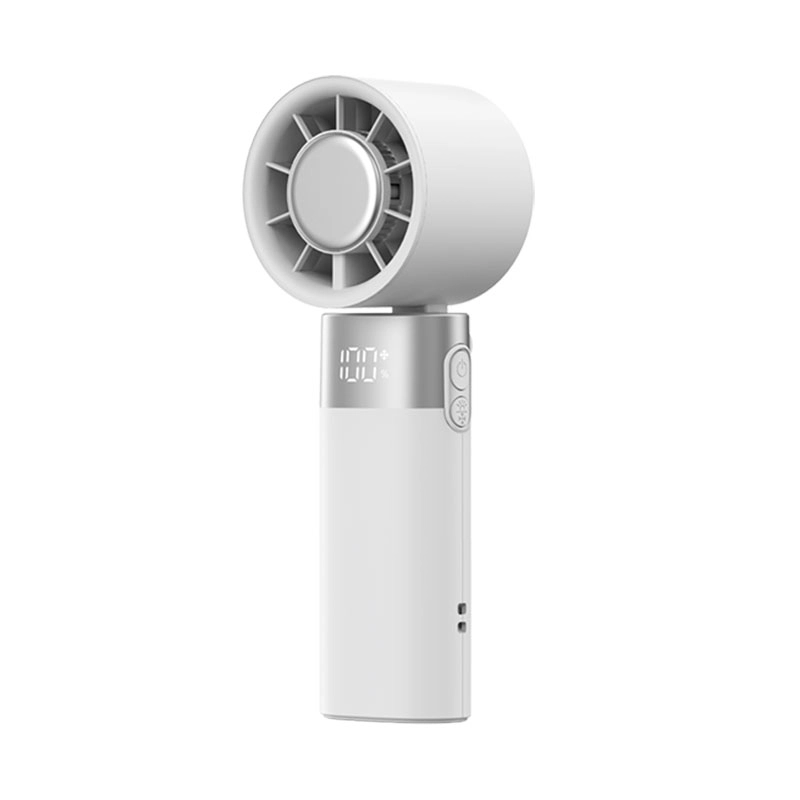
Reliable Handheld Cooling Solution for Bulk & Corporate Purchases
This premium handheld fan is designed for high-frequency, large-volume usage, making it an ideal cooling solution for corporate procurement, promotional distribution, employee welfare programs, and retail wholesale.
With stable airflow performance, a rechargeable design, and lightweight portability, it helps businesses deliver practical comfort products with strong perceived value while maintaining cost efficiency and supply reliability.
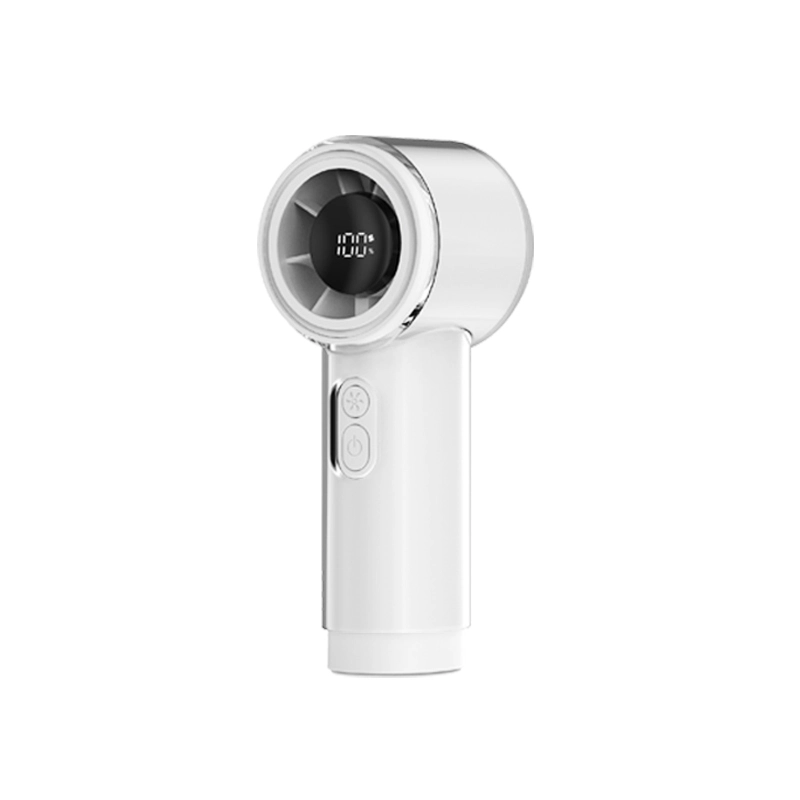
Customizable High-Speed Portable Handheld Fan FS2663
This is a high-speed, long-lasting, personalized, custom, portable cooling product specially designed for gift purchasers, cross-border e-commerce sellers, and OEM/ODM cooperation enterprises. It features (1) strong wind speed, (2) lightweight portability, (3) transparent shell design, (4) convenient carrying with a hand rope, and (5) long battery life. It helps enterprises enhance brand exposure, product differentiation competitiveness, and customer repeat purchase rate.
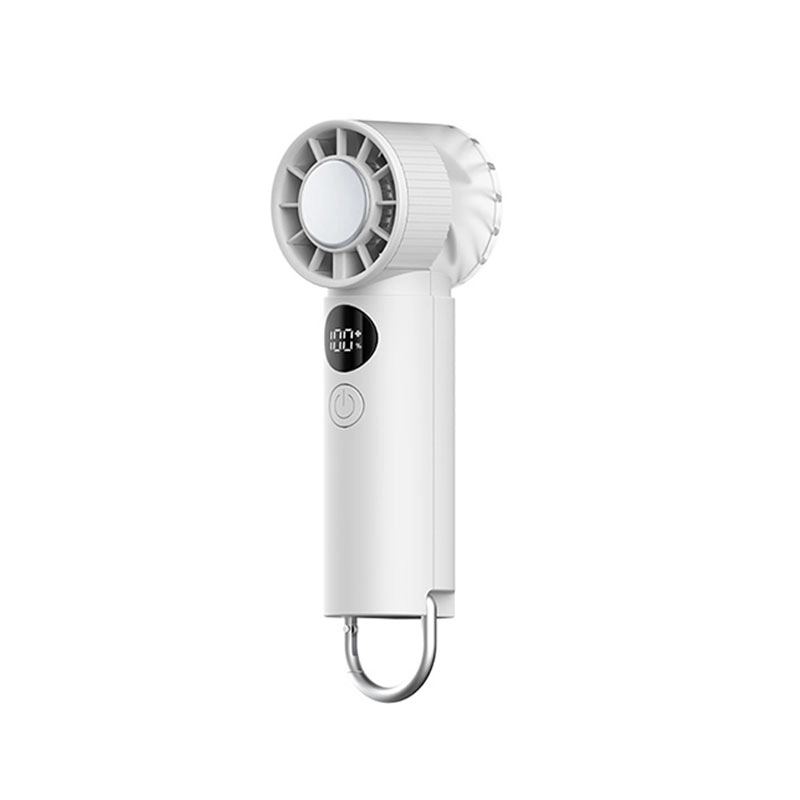
Customizable lightweight mini handheld cooling fan (with climbing hook) FS2666
A portable cooling and personalized customization product specially designed for commuters, students, the gift customization industry, and OEM/ODM buyers. It features (1) lightweight and easy portability, (2) a climbing buckle, and (3) semiconductor cooling.
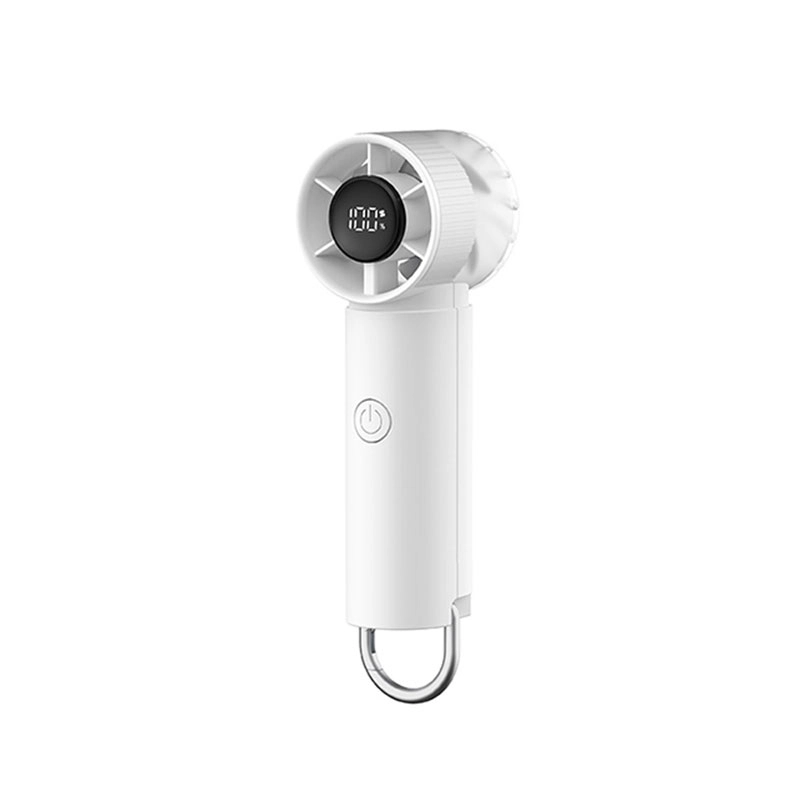
Customizable lightweight mini handheld cooling fan (with climbing hook) FS2667
This is a lightweight and portable + personalized customization product specially designed for commuters, students, the gift customization industry, and OEM/ODM buyers. It features (1) lightweight and easy portability, (2) a climbing buckle, and (3) a semi-transparent air duct design.
Start Your Custom Handheld Fans Manufacturing Project Today
If you have any comments or good suggestions, please leave us a message; later our professional staff will contact you as soon as possible.
Contact


4th Floor, Building 3, Jurong Industrial Park, No. 27-1-1, Fu'an Industrial Zone,Leliu Town (Pancun), Shunde District, Foshan City, Guangdong Province
 Scan QR Code
YouTube
Twitter
Facebook