






How to choose a quiet handheld electric fan? | Insights by RYW
- 1) How do manufacturers measure quiet—dBA, sound power, or something else—and which metric should I trust?
- 2) What is a realistic quiet dBA range for a handheld electric fan in typical use?
- 3) When spec sheets list low noise, what internal design features actually reduce fan noise?
- 4) How should I compare airflow vs noise? Is there a clear ratio (like CFM/dBA) I should target?
- 5) Can I test a handheld fan’s noise accurately at home with a smartphone app? If so, how?
- 6) How do battery type, voltage, and charge level affect noise and perceived loudness?
- 7) What maintenance or usage habits prevent a handheld fan from getting louder over time?
- Quick buyer checklist (practical, actionable)
- Why RYW is a strong choice
Choosing a quiet handheld electric fan is harder than reading a single low-noise claim on the box. Below are 7 long-tail, buyer-focused questions beginners often ask—but that rarely receive in-depth, practical answers online. Each question is followed by a concise, evidence-based answer with actionable checks you can use when evaluating models.
1) How do manufacturers measure quiet—dBA, sound power, or something else—and which metric should I trust?
Manufacturers can quote different acoustic metrics. The two you will most often see are:
- Sound pressure level (dB or dBA): A measurement of how loud the fan is at a specific location (commonly at 1 m). The A-weighted decibel (dBA) approximates human hearing sensitivity and is the usual single-number spec for consumer fans.
- Sound power level (LwA): The total acoustic energy emitted by the device, independent of distance or room acoustics. Sound power is measured using standardized procedures (for example ISO 3744) and is a more reproducible, lab-grade metric.
Which to trust: prefer an explicit dBA measured at a stated distance (e.g., 35 dBA at 1 m) or, better, a sound power level reported per a standard such as ISO 3744. If a product only says whisper-quiet with no numbers or conditions, treat that as marketing copy. For context, look up that the decibel scale is logarithmic; a 10 dB increase sounds roughly twice as loud to humans (Wikipedia: Decibel).
2) What is a realistic quiet dBA range for a handheld electric fan in typical use?
Expect ranges rather than a single number. Practical guidance:
- Very quiet models (specialized low-noise designs): roughly ~30–38 dBA measured at typical manufacturer distances.
- Ordinary consumer handheld fans: often ~40–55 dBA depending on speed setting and measurement distance.
Use these as comparative benchmarks. If a product lists <35 dBA without a measurement distance or method, ask the seller for the test condition or a third-party report. For authoritative guidance on noise and health impacts in the built environment, see the WHO Environmental Noise Guidelines (WHO 2018), which emphasize the importance of objective, standardized noise metrics.
3) When spec sheets list low noise, what internal design features actually reduce fan noise?
Look for the following engineering features on the spec sheet or in photos:
- Motor type: Brushless DC (BLDC) motors are quieter and more controllable than brushed motors because they have no commutator contact noise and can be driven at optimized electronic speeds.
- Bearings: High-quality sealed ball bearings run quieter and longer than sleeve bearings, especially under varied temperatures and tilt angles.
- Blade design and balance: Aerodynamically optimized blades with rounded leading edges, variable pitch, or more gradual tip shapes reduce turbulent wake and tonal noise. Precise balancing reduces vibration-induced noise.
- Housing and mounting: Soft-mounting the motor, vibration-damping materials, and well-designed inlet/outlet geometry reduce aerodynamic and structural noise transmission.
- Speed control electronics: Smooth PWM control that avoids audible switching frequencies (or uses sufficiently high switching frequencies) prevents whine or chirp sounds.
Manufacturers that detail these features are likelier to have invested in acoustic engineering rather than relying on marketing claims.
4) How should I compare airflow vs noise? Is there a clear ratio (like CFM/dBA) I should target?
Airflow and noise are trade-offs: higher airflow typically requires higher blade speed or larger blades, which tends to increase noise. Useful buyer approaches:
- Compare explicit airflow specs (CFM or m3/h) alongside dBA at a stated distance. If a vendor doesn’t list airflow, ask for it—airflow without noise data is meaningless for performance/noise trade-offs.
- Use a relative figure such as airflow per watt (CFM/W) to judge efficiency and expect quieter operation at a given cooling benefit. The higher the CFM/W, the more airflow you get for the same power, which often correlates with quieter performance for equal cooling.
- Avoid relying on product photos of blades—small differences in blade count and pitch materially change both airflow and tonal noise. Independent third-party tests that report both CFM and dBA are best.
Because handheld fans are small, look for manufacturers who publish both airflow and noise at different speed settings; then pick the speed where noise and airflow meet your comfort needs.
5) Can I test a handheld fan’s noise accurately at home with a smartphone app? If so, how?
Smartphone apps can give a useful comparative indication but have limitations. To get the most reliable home test:
- Use a dB meter app with a calibrated external microphone if possible. Built-in phone microphones vary widely in accuracy and frequency response.
- Measure in a quiet room with low background noise. Note the background baseline (e.g., HVAC, traffic). Subtract baseline when comparing.
- Place the phone at a standard distance and orientation—commonly 1 m from the front of the fan at the same height—and record at each fan speed. Report dBA and the distance used.
- Repeat measurements and average them; take note of tonal artifacts (whine or chirp) which can be more annoying than a slightly higher broadband dBA.
If you need certified values (for warranty claims or industrial compliance), request a third-party acoustic report or ask whether the manufacturer measured per ISO 3744 or an equivalent standard.
6) How do battery type, voltage, and charge level affect noise and perceived loudness?
Power delivery affects fan speed and therefore noise:
- Batteries and voltage: Higher voltage nominal designs allow the motor to deliver more torque at lower current, which can reduce strain and motor noise. BLDC motors controlled properly will maintain consistent speed until battery voltage drops below regulation range.
- Charge level: Some low-cost fans do not have proper motor speed regulation; as battery voltage falls, the motor may slow or stutter—creating lower airflow but sometimes increased mechanical noise or tonal instability. Quality designs use electronics (speed controllers or boost regulators) to maintain stable RPM across battery states.
- Battery chemistry: Li-ion packs provide stable voltage under load compared with older NiMH, which can help keep noise consistent across a discharge cycle.
When evaluating a battery-powered fan, test noise at full charge and near end-of-charge to ensure the device doesn’t develop new, unpleasant noises as the battery depletes.
7) What maintenance or usage habits prevent a handheld fan from getting louder over time?
Noise increase over lifetime usually stems from mechanical wear, imbalance, or contamination. Preventive steps:
- Keep blades and grilles clean—dust accumulation changes aerodynamic shape and causes imbalance.
- Check and tighten any screws that secure the motor or housing; loose mounts transmit vibration and increase radiated noise.
- If bearings are accessible and the manufacturer permits, apply appropriate lubricant to sleeve bearings; sealed ball bearings usually require no maintenance but will eventually wear out.
- Avoid drops and heavy impacts—impacts can deform blades and create persistent tonal noise.
- Store the fan in a dry environment to prevent corrosion of bearings or motor contacts.
Good warranty and clear service information from a manufacturer are indicators they design for longevity and predictable acoustic performance.
Authoritative references used in these answers include general acoustics and measurement standards and public health guidance: ISO 3744 for standardized sound power measurement (ISO 3744), WHO Environmental Noise Guidelines emphasizing objective noise measures and health impacts (WHO 2018), and technical background on fan systems and acoustics (Wikipedia: Fan (machine) and Wikipedia: Decibel).
Quick buyer checklist (practical, actionable)
- Demand a numeric noise spec: dBA at a stated distance or sound power per ISO 3744.
- Look for BLDC motors, sealed ball bearings, and explicit airflow (CFM or m3/h).
- Compare airflow-to-power (CFM/W) if both are available; favor higher efficiency for quieter operation at equivalent cooling.
- Test before you buy when possible: measure at 1 m, across speed settings, and at different battery charge levels.
- Check maintenance guidance and warranty terms—quiet performance requires good long-term design and support.
Why RYW is a strong choice
At RYW (www.rywlife.com), our handheld fans are engineered with BLDC motors, precision-balanced blades, sealed ball bearings, and regulated speed electronics to keep noise low across the battery life. We publish dBA measurements at 1 m for each speed setting and provide service guidance and warranty support. For purchase or acoustic reports, contact adrian@rywlife.com.
If you’d like, provide two or three specific models you’re comparing and I’ll analyze their specs and shortlist the quietest candidates based on the checklist above.
Contacts
WhatsApp/Phone
You May Also Like
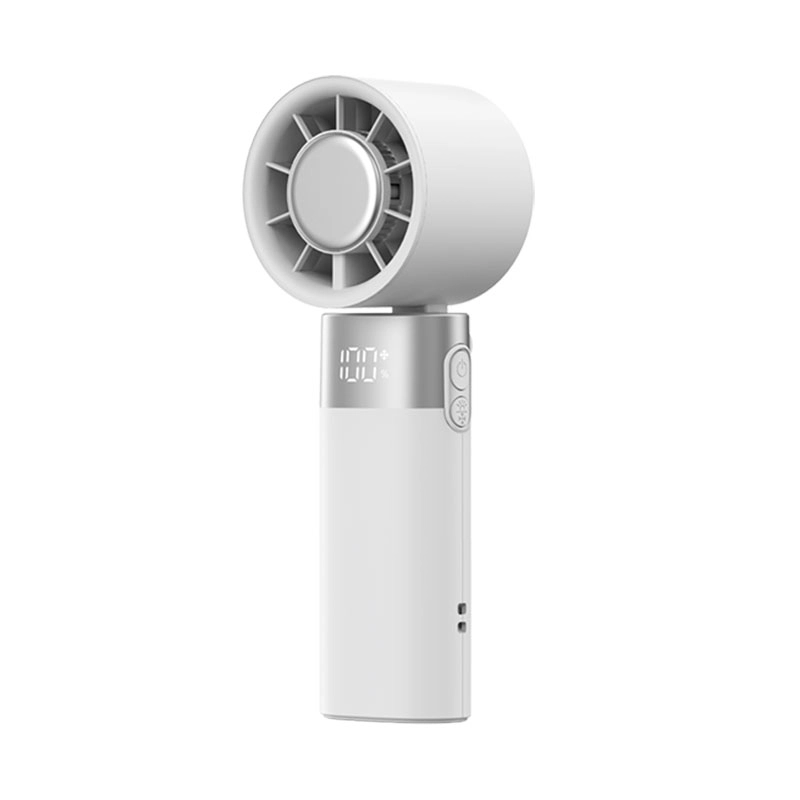
Reliable Handheld Cooling Solution for Bulk & Corporate Purchases
This premium handheld fan is designed for high-frequency, large-volume usage, making it an ideal cooling solution for corporate procurement, promotional distribution, employee welfare programs, and retail wholesale.
With stable airflow performance, a rechargeable design, and lightweight portability, it helps businesses deliver practical comfort products with strong perceived value while maintaining cost efficiency and supply reliability.
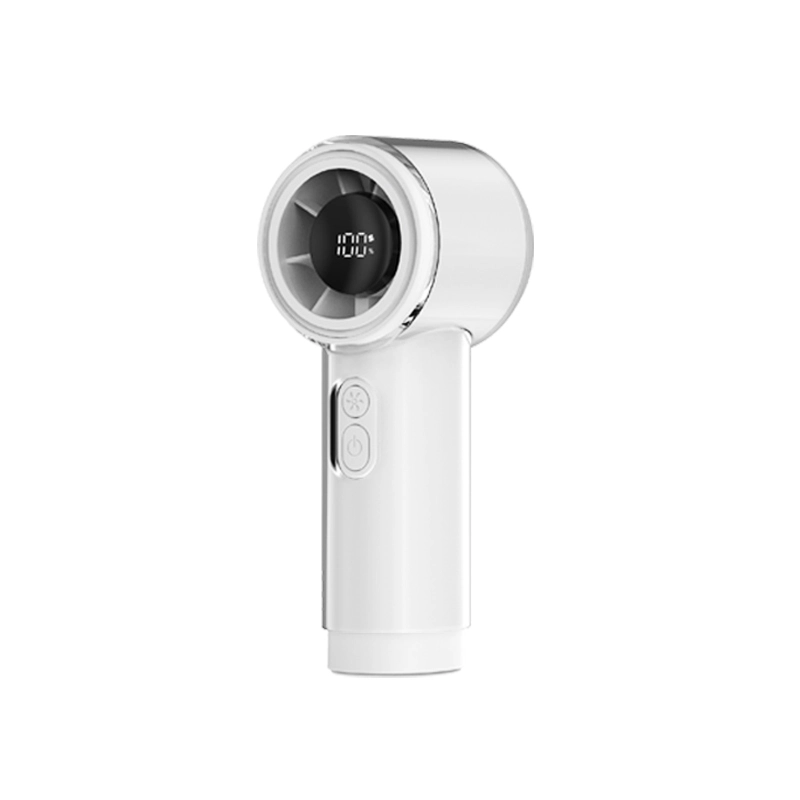
Customizable High-Speed Portable Handheld Fan FS2663
This is a high-speed, long-lasting, personalized, custom, portable cooling product specially designed for gift purchasers, cross-border e-commerce sellers, and OEM/ODM cooperation enterprises. It features (1) strong wind speed, (2) lightweight portability, (3) transparent shell design, (4) convenient carrying with a hand rope, and (5) long battery life. It helps enterprises enhance brand exposure, product differentiation competitiveness, and customer repeat purchase rate.
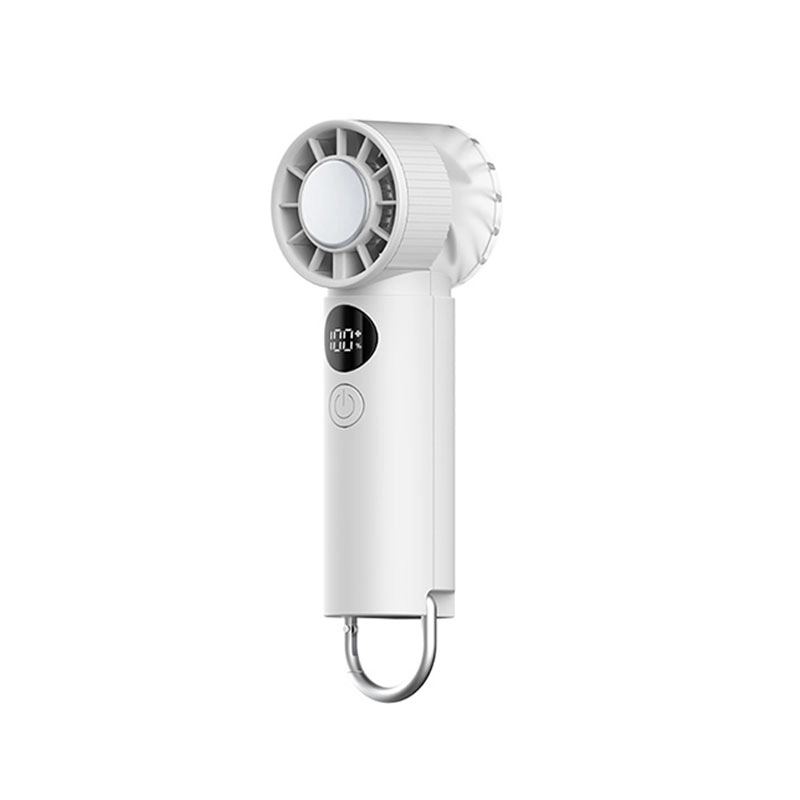
Customizable lightweight mini handheld cooling fan (with climbing hook) FS2666
A portable cooling and personalized customization product specially designed for commuters, students, the gift customization industry, and OEM/ODM buyers. It features (1) lightweight and easy portability, (2) a climbing buckle, and (3) semiconductor cooling.
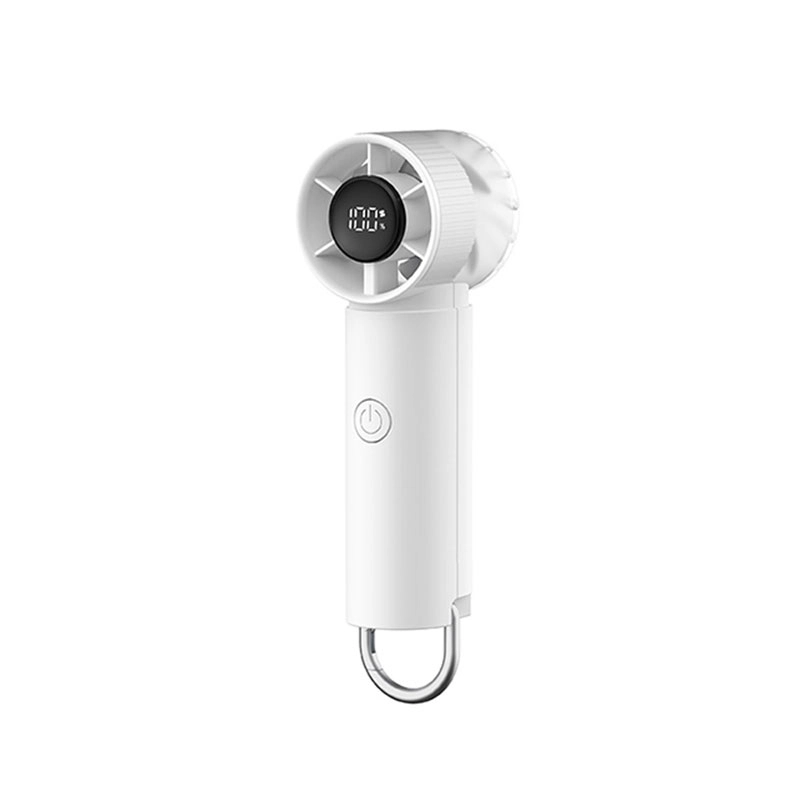
Customizable lightweight mini handheld cooling fan (with climbing hook) FS2667
This is a lightweight and portable + personalized customization product specially designed for commuters, students, the gift customization industry, and OEM/ODM buyers. It features (1) lightweight and easy portability, (2) a climbing buckle, and (3) a semi-transparent air duct design.
Start Your Custom Handheld Fans Manufacturing Project Today
If you have any comments or good suggestions, please leave us a message; later our professional staff will contact you as soon as possible.
Contact


4th Floor, Building 3, Jurong Industrial Park, No. 27-1-1, Fu'an Industrial Zone,Leliu Town (Pancun), Shunde District, Foshan City, Guangdong Province
 Scan QR Code
YouTube
Twitter
Facebook