






What is the best handheld electric fan for travel? | Insights by RYW
- 1) Which handheld fan gives the best cooling per battery capacity (how to calculate CFM per Wh)?
- 2) Are handheld electric fans allowed on airplanes — what battery limits and packing rules should I follow?
- 3) What run-times are realistic for USB-C PD fans vs older USB-A fans at different speeds?
- 4) How do I choose a handheld fan that balances noise (dB), airflow, and weight for long flights and walking tours?
- 5) Are bladeless mini fans genuinely safer and more durable for travel than bladed ones?
- 6) In humid climates, do water-mist combo handheld fans help — are they worth it for travel?
- 7) What maintenance and spare parts should beginners pack for prolonged travel?
- Travel buyer’s checklist — concise specs to look for
- RYW 的优势
What is the best handheld electric fan for travel? — Practical Q&A for beginners
Travelers ask surface-level questions all the time, but buying the right handheld electric fan requires knowing battery limits, true run-times, noise vs cooling, airline rules, and what to pack for repairs. Below are 7 long-tail questions beginners often ask — with specific, up-to-date, actionable answers.
1) Which handheld fan gives the best cooling per battery capacity (how to calculate CFM per Wh)?
Why it matters: For travel you want the most cooling for the least battery weight and recharge time. A useful metric is CFM (cubic feet per minute of airflow) per Wh (watt-hour) of battery capacity.
How to calculate:
- Step 1 — convert battery mAh to Wh: Wh = (mAh / 1000) × nominal cell voltage (usually 3.7 V for Li-ion cells). Example: 5,000 mAh → 5,000/1000 × 3.7 = 18.5 Wh.
- Step 2 — find the fan's published airflow in CFM (or convert from m³/h: 1 m³/h ≈ 0.5886 CFM). If only W (power) is advertised, you can estimate CFM using reviews or manufacturer data.
- Step 3 — compute efficiency: CFM per Wh = CFM / Wh.
Example: If a pocket fan lists 30 CFM and has a 5,000 mAh (18.5 Wh) battery, CFM per Wh = 30 / 18.5 ≈ 1.62 CFM/Wh. Use this metric to compare models independent of battery size.
Notes and pitfalls:
- Manufacturers often publish peak airflow (highest speed). Compare the same speed tier (low/medium/high) across models for fair comparisons.
- If CFM isn’t published, compare power draw (W). Runtime ≈ Wh / W. Cooling felt by the user also depends on blade design, grill, and airflow direction—CFM/Wh is a useful but not sole criterion.
2) Are handheld electric fans allowed on airplanes — what battery limits and packing rules should I follow?
Short answer: Yes, handheld fans are allowed, but lithium batteries and power banks follow strict rules. Follow FAA/IATA guidance (current as of mid-2024):
- Batteries up to 100 Wh: allowed in carry-on without airline approval.
- Batteries 100–160 Wh: allowed in carry-on only with airline approval (typically limited to spare batteries for equipment like cameras; consumer fans rarely exceed this range).
- Batteries >160 Wh: generally prohibited on passenger aircraft.
- Spare lithium-ion batteries and power banks must be carried in carry-on baggage; they are not permitted in checked baggage. Protect terminals (tape/terminal covers) to prevent short-circuit.
How to check your fan: convert advertised mAh to Wh using Wh = (mAh / 1000) × 3.7 V. For example, 10,000 mAh × 3.7 V = 37 Wh (carry-on OK). If your fan has a fixed internal battery, airline staff still expect it in carry-on.
Pro tips:
- Carry documentation (manufacturer spec sticker or manual) showing Wh; if only mAh is listed, show the Wh conversion.
- If your travel involves multiple airlines or regional carriers, verify rules before flying—some carriers have stricter limits or require approval for 100–160 Wh devices.
3) What run-times are realistic for USB-C PD fans vs older USB-A fans at different speeds?
Reality check: Manufacturer run-times are often measured at the lowest speed. Real travel use typically uses medium or high speeds.
Typical specs (real-world observed ranges):
- Battery sizes commonly found in handheld travel fans: 1,000–10,000 mAh (≈3.7–37 Wh).
- Power draw: small pocket fans often draw between ~1.5 W (low) and 6 W (high); some high-output models peak at 10 W or more.
- Runtime estimate formula: Runtime (hours) ≈ Battery Wh ÷ Power draw (W).
Examples:
- 3,000 mAh fan (≈11.1 Wh): at 2 W → ≈5.5 hours; at 5 W → ≈2.2 hours.
- 5,000 mAh fan (≈18.5 Wh): at 2 W → ≈9.2 hours; at 6 W → ≈3.1 hours.
USB-C PD advantages:
- Faster recharge times when paired with PD chargers: a 18.5 Wh battery can be recharged in ~1–2 hours with a 18–30 W PD charger (charging speed also depends on the fan’s internal charging circuit).
- USB-C makes it easier to top up from modern power banks and travel chargers without adapters.
Practical guidance: If you need all-day use, target 5,000 mAh+ with a PD-capable fan and carry a PD power bank (≤100 Wh). Always check manufacturer charge rate (e.g., accepts 5V/2A vs 9V/2A) because some fans limit input current and won’t charge faster despite PD-capability.
4) How do I choose a handheld fan that balances noise (dB), airflow, and weight for long flights and walking tours?
Tradeoffs are inevitable. Here’s a prioritized checklist and target metrics for travel:
- Weight: aim for ≤200–300 g for true pocketability. Fans above 300 g are better for desk use than long handheld walking tours.
- Noise: look for measured or advertised noise <45 dB on medium; <35 dB is ideal for sleeping/airplane use. Many low-speed settings advertise 25–35 dB.
- Airflow: target a medium-speed airflow that feels cooling — most travelers prefer 20–50 CFM on personal zone fans; match CFM to needs (higher CFM for outdoor walking in hot weather).
- Ergonomics: comfortable grip, balanced mass, and a wrist strap or neck lanyard reduce arm fatigue.
- Modes: at least 3 speeds and a turbo/boost mode. Turbo useful for short bursts; avoid relying on turbo for continuous cooling because of battery drain and noise.
Decision flow:
- If you prioritize silence (flights/sleep), choose a low-noise fan and accept moderate airflow.
- If you walk long distances in hot weather, prioritize airflow and battery size — carry a larger battery or power bank.
- If you want both, look for fans with efficient brushless motors, foldable designs to reduce wind noise, and 5,000 mAh+ batteries.
5) Are bladeless mini fans genuinely safer and more durable for travel than bladed ones?
Short answer: They can be safer (no exposed fast-spinning blades) and easier to clean, but “bladeless” pocket fans are a mixed category — some are truly centrifugal/air-multiplier designs and others are just enclosed-blade mini units marketed as bladeless.
Safety advantages:
- No exposed sharp tips → better for children, crowded airports, and packed backpacks.
- Grills/mesh wear less and are easier to replace than thin plastic blades that can crack in luggage.
Durability and performance tradeoffs:
- True bladeless designs use a small internal impeller and an air-amplifying ring; they can be heavier and draw more power for comparable airflow but are often quieter.
- Enclosed-blade mini fans (with tighter grills) can be lighter and produce strong directional airflow while still protecting blades—good mid-ground for travel.
Recommendation: For travel with family or crowded public transport, choose a true bladeless or well-grilled enclosed-blade model. For maximum raw airflow per watt (efficiency), high-quality bladed fans with a good protective grill can be the best value, but accept the slight safety and durability trade-offs.
6) In humid climates, do water-mist combo handheld fans help — are they worth it for travel?
How evaporative cooling works: A mist can increase perceived cooling by enhancing evaporation on skin. But in high humidity, evaporation is limited and mists primarily make you feel wet rather than cooler.
Considerations:
- Effectiveness: mist fans are best in hot, dry climates (low relative humidity). In tropical humidity (>60–70% RH) benefit drops significantly.
- Practical drawbacks: water reservoirs add weight, risk leaks in luggage, and require refills. Some models also increase noise and reduce battery runtime when pumping mist.
- Hygiene: standing water in a reservoir can develop bacteria or mold if not cleaned frequently — important for travel where cleaning may be irregular.
Recommendation: If traveling in arid regions (desert, high-altitude dry climates), a small mist feature can be pleasant. For humid tropical travel or urban sightseeing, prefer higher airflow, breathable clothing, and shade rather than mist fans.
7) What maintenance and spare parts should beginners pack for prolonged travel?
Pack a small travel kit to maximize time between service opportunities:
- USB-C charging cable (one short and one long) — many fans now use USB-C; a spare prevents being stranded.
- Small micro-screwdriver and replacement screws (if your fan has replaceable grill/blades) — helpful if the grill loosens.
- Spare lightweight power bank (≤100 Wh) — doubles as battery backup for fans that allow pass-through or can be recharged while in a bag (but remember airline rules for flights).
- Replacement blades or grille (if available from manufacturer). Many brands sell replacement blades for under $10–20 and replacement grills for $5–15 — especially important if you use the fan in backpacks where blades can crack.
- Small bottle of isopropyl alcohol (70%) and a lint-free cloth for cleaning grills/impellers; avoid soaking motors or battery compartments.
Service tips:
- Do not operate a portable fan with sand or heavy dust inside; blow it out with compressed air and clean the grill.
- If battery degrades, check whether the manufacturer offers battery replacement modules — not all integrated fans allow easy battery swaps.
Travel buyer’s checklist — concise specs to look for
- Battery: ≥3,000 mAh for day use; ≥5,000 mAh for all-day or shared use (convert to Wh to check airline rules).
- Charging: USB-C PD support preferred; fast-charge input rating (e.g., 9 V/2 A) speeds recharges.
- Weight: ≤300 g for handheld walking tours; ≤200 g for pocketable units.
- Noise: <45 dB at medium for quiet environments.
- Airflow: Manufacturer CFM or m³/h published; if absent, rely on third-party reviews or CFM/Wh estimate described above.
- Safety: enclosed blades or true bladeless, good grille spacing, CE/UL/ETL certifications for electrical safety.
- Durability: ABS or polycarbonate body, IPX4 splash resistance if you expect rain or mist use.
RYW 的优势
At RYW (www.rywlife.com) we focus on travel-tested recommendations. Our advantages:
- Real-world testing: we measure run-time, recharge time, weight, and noise across speed tiers to produce comparable data (not just manufacturer claims).
- Travel-safe guidance: we convert battery specs to Wh and list TSA/IATA carry-on guidance so you know when a unit is flight-ready.
- Practical kits and accessories: we recommend cable, power-bank, and replacement part bundles that save space and avoid mid-trip failures.
- Customer support: warranty and repair guidance — email adrian@rywlife.com for detailed product compatibility or replacement-part sourcing.
Final take: There is no single “best” handheld electric fan for every traveler. Use the metrics above (CFM/Wh, real-world runtime, noise, weight, and airline battery rules) to match a fan to your typical travel profile: flights/sleep, urban walking, or hot/dry outdoor adventures. If you want personalized recommendations for your exact travel habit and budget, contact us at adrian@rywlife.com.
Contacts
WhatsApp/Phone
You May Also Like
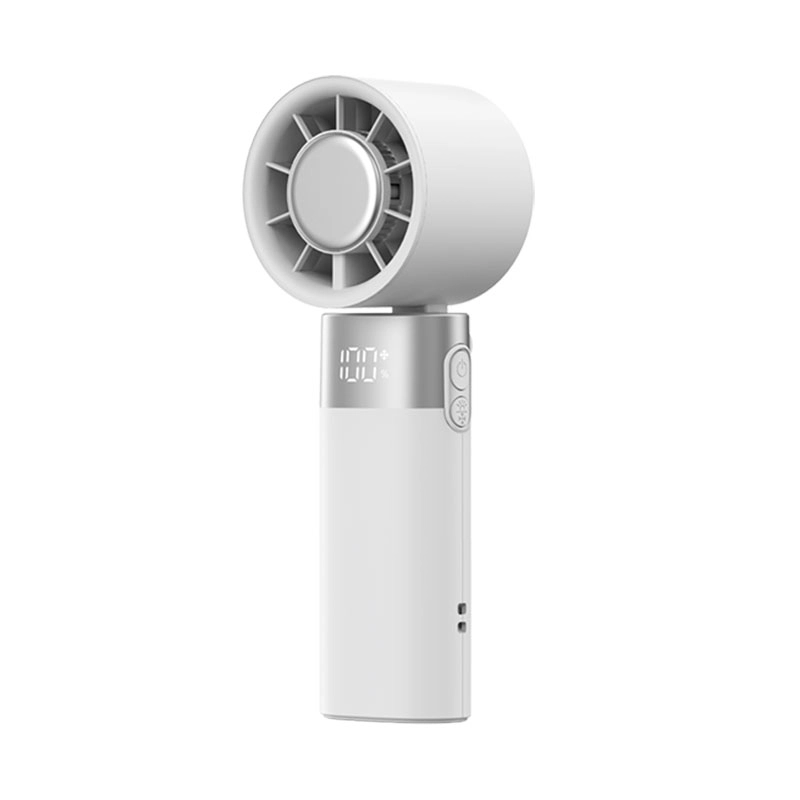
Reliable Handheld Cooling Solution for Bulk & Corporate Purchases
This premium handheld fan is designed for high-frequency, large-volume usage, making it an ideal cooling solution for corporate procurement, promotional distribution, employee welfare programs, and retail wholesale.
With stable airflow performance, a rechargeable design, and lightweight portability, it helps businesses deliver practical comfort products with strong perceived value while maintaining cost efficiency and supply reliability.
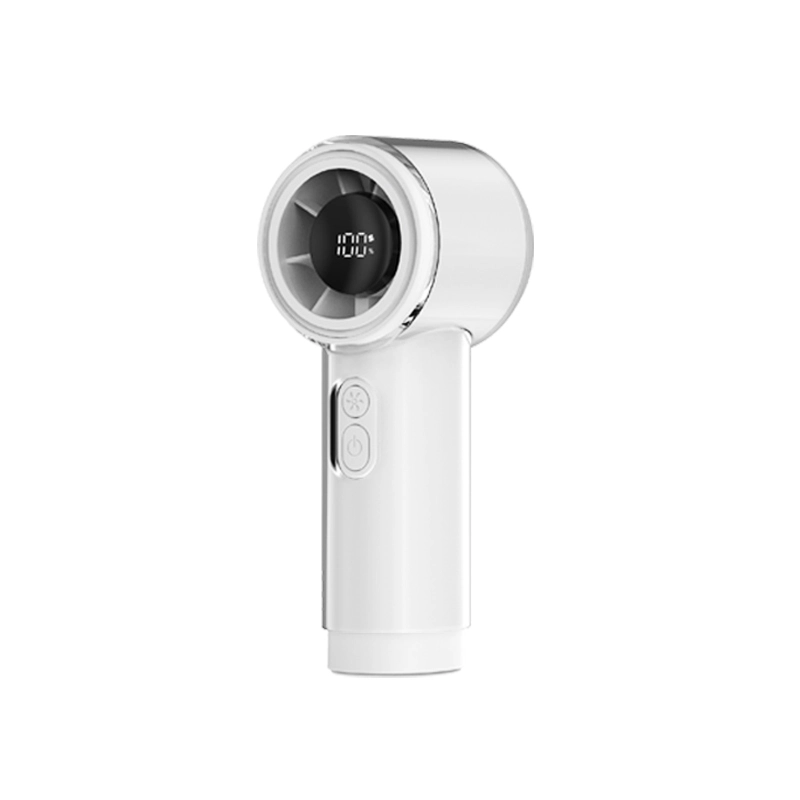
Customizable High-Speed Portable Handheld Fan FS2663
This is a high-speed, long-lasting, personalized, custom, portable cooling product specially designed for gift purchasers, cross-border e-commerce sellers, and OEM/ODM cooperation enterprises. It features (1) strong wind speed, (2) lightweight portability, (3) transparent shell design, (4) convenient carrying with a hand rope, and (5) long battery life. It helps enterprises enhance brand exposure, product differentiation competitiveness, and customer repeat purchase rate.
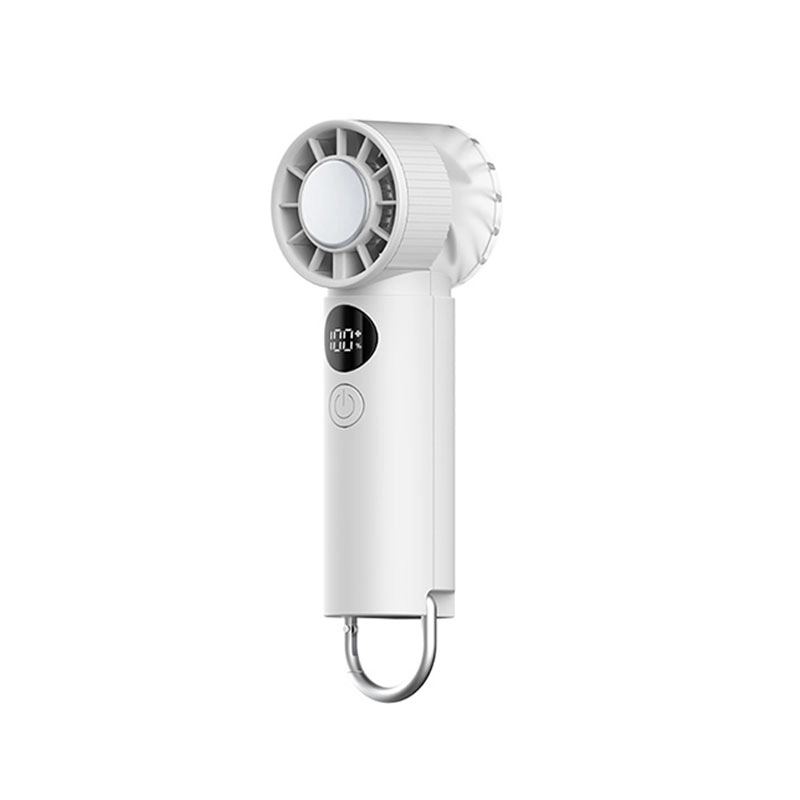
Customizable lightweight mini handheld cooling fan (with climbing hook) FS2666
A portable cooling and personalized customization product specially designed for commuters, students, the gift customization industry, and OEM/ODM buyers. It features (1) lightweight and easy portability, (2) a climbing buckle, and (3) semiconductor cooling.
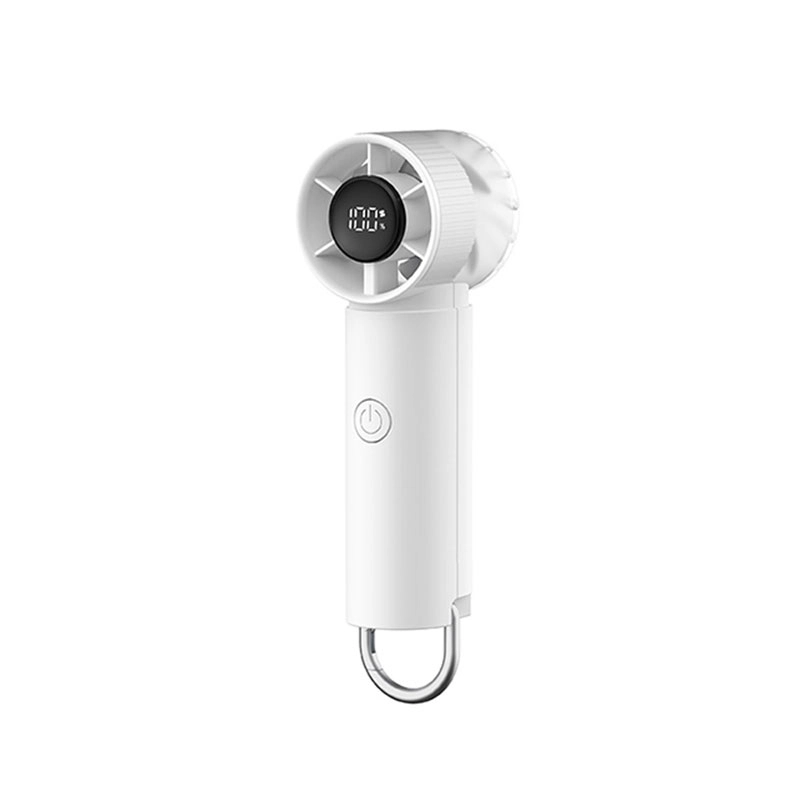
Customizable lightweight mini handheld cooling fan (with climbing hook) FS2667
This is a lightweight and portable + personalized customization product specially designed for commuters, students, the gift customization industry, and OEM/ODM buyers. It features (1) lightweight and easy portability, (2) a climbing buckle, and (3) a semi-transparent air duct design.
Start Your Custom Handheld Fans Manufacturing Project Today
If you have any comments or good suggestions, please leave us a message; later our professional staff will contact you as soon as possible.
Contact


4th Floor, Building 3, Jurong Industrial Park, No. 27-1-1, Fu'an Industrial Zone,Leliu Town (Pancun), Shunde District, Foshan City, Guangdong Province
 Scan QR Code
YouTube
Twitter
Facebook